Using rail for people and goods

Highlights of Washington’s passenger rail network program over the last five years include:

  • Significant increase in ridership in 2024 compared to 2023: A record-breaking 40% increase in riders on Amtrak Cascades; an 11% increase on the Empire Builder; a 12.5% increase on Sounder trains; and a 6% increase on Coast Starlight.
  • Five federal grants awarded between 2020 and 2024 for capital improvements along the BNSF corridor in western Washington to reduce landslide risk, rehabilitate bridge structures and make track and switch improvements.

BNSF Railway is the major Class I railroad in the state, with Union Pacific also operating some rail lines. Over the last 15 years, WSDOT and BNSF have developed a collaborative relationship leading to more than $920 million in capital investments to improve the network.

Washington’s 27 short-line railroads also play an important role in transporting goods. The state’s largest short-line railroad system, the PCC Railway, is owned by WSDOT and operates in eastern Washington. It primarily moves agriculture products to national and international markets. WSDOT also provides grants and loans to short-line railroads to help fund improvements.

Purpose of State Rail Plan

Rail is an important part of our Washington statewide transportation system that keeps people and businesses moving. Whether moving products from the eastside of the state to western Washington ports and beyond, connecting passengers to cities in Washington, British Columbia and Oregon, or transporting commuters to work and home, our rail network helps our economy, environment and quality of life. As demand for rail increases, future service and infrastructure must be planned.

This plan is intended to provide direction for the state rail network investments over the next 20 years, supported with tangible actions in the near, mid and long term for WSDOT and its railroad partners. Investments lead to improved passenger rail service and goods movement between key markets in the state and region. Your input on the plan will help form the goals for the statewide rail network that investments are measured against. Measurable performance objectives will be developed under each goal category to track our progress.

Goals and planning

The following are goals that reflect existing rail plans and state transportation policies that will be included in the rail plan. The State Rail Plan will show metrics associated with each goal.

  • Mobility

    Streamline the rail network as part of the statewide multimodal transportation system.

    Promote the rail system for passengers and freight shippers by enhancing service reliability, schedules, local connections, and more choices to meet demand.

    Could focus on enhancing service integration and reliability, which may include the number and timing of trips, ability to reach other destinations from rail hubs, like jobs, events, universities, hospitals, or airports through connected local transfers.
  • Economic vitality

    Enhance rail's contribution to Washington state's economy.

    Increase rail access for passengers and freight to boost economic opportunities, ease demands on the highway system and improve communities' quality of life statewide.

    Future strategies could emphasize serving a regional workforce with access to affordable housing centers. It could focus on how freight serves a statewide economy, including access to the rail network and the transfer of freight to trains, trucks, or cargo ships.

  • Preservation

    Ensure current assets and future investments are preserved and maintained.

    Strengthen rail owners' and operators' ability to maintain industry standards, as they keep rail cars, tracks and facilities working to their highest capability.

    Considers how to maintain, preserve and extend the life and utility of prior investments in rail systems and services. This includes the preservation of infrastructure needed to support rail network operations.

  • Environment

    Increase the environmental sustainability of the Washington transportation system through rail improvements

    Identify how to align greenhouse gas emission reductions codified in state law by lowering the rail contribution to emissions as well as encouraging increased rail use for moving people and freight.

    Could focus on how the rail system to support climate and other environmental goals, including trains that reduce emissions, rail service that support a reduction in vehicle miles traveled.

  • Stewardship

    Steward a rail network that benefits all communities in Washington.

    Prioritize programs and investments that promote an efficient, resilient, and equitable rail network across the state for movement of people and freight.

    This could include actions that make the rail network less vulnerable to major disruptions. It could meet the needs of each community by responding to local needs in a fair and equitable way.

  • Safety

    Strive for zero fatalities and serious injuries on the rail network.

    Prioritize improvements and education that increase safety by reducing injuries, fatalities and collisions.

    Future investments could include addressing rail crossings, safety education and/or adding fencing along certain corridors.

Key findings and State Rail Plan preview

The following is a preview of key findings and general strategies of the 2025 State Rail Plan. During our first phase of engagement in Spring 2025, commenters had a high degree of interest in mobility, including on-time performance and frequency of passenger service. They also focused on safety as an important goal. We have oriented this preview content around these focus areas. The full document will be available later this spring, and will include many additional details about the statewide rail network.

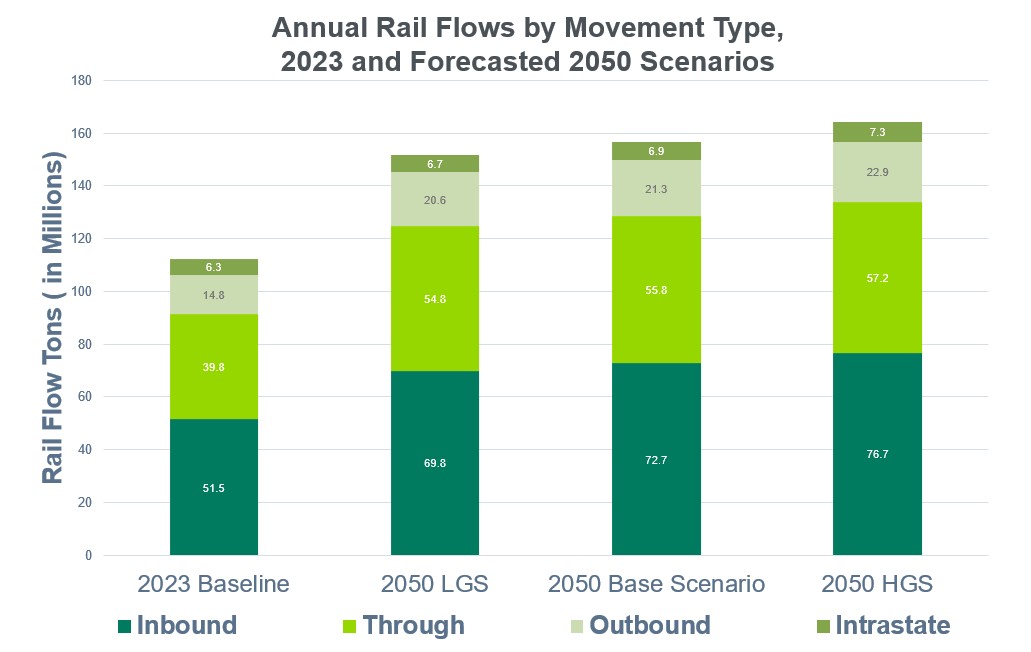
By 2050, the freight rail system is projected to haul 36% to 45% more tonnage, while 1.5 to 3 times as many passenger trains use some routes over today.

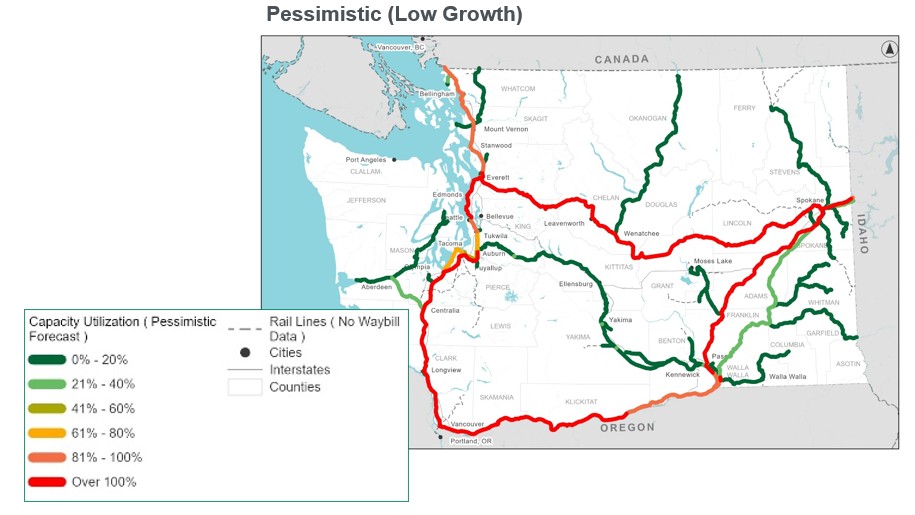
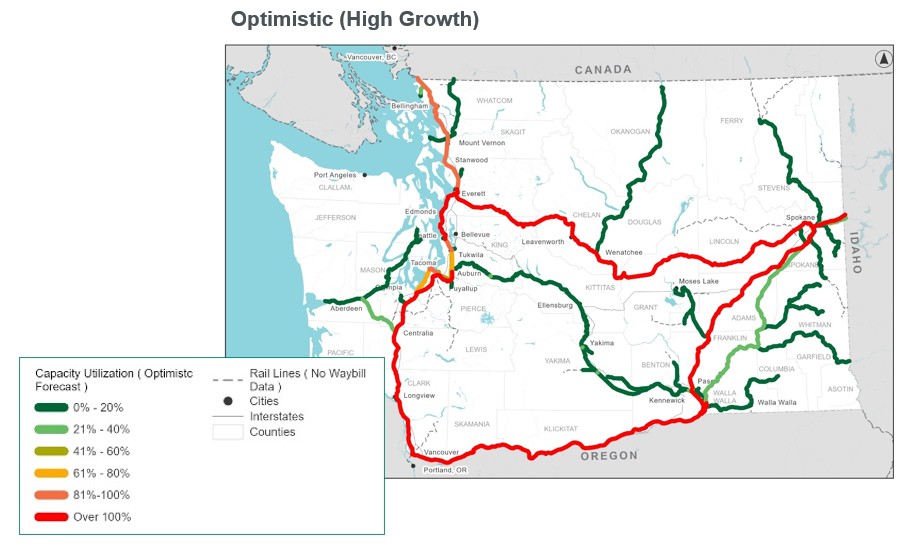
With continued growth in Washington State, the expected rail traffic will exceed our estimated capacity of the current network in several locations. However, there are a number of things that affect capacity such as available infrastructure, operating strategies, traffic, the use of technology, and business decisions. Privately-owned railroads manage their operations and capital investments to meet changes in traffic volumes on their systems.

Increasing passenger rail service could create constraints on parts of the statewide rail network.

Strategy: Include projects that will address capacity issues for freight and passenger service.

Image descriptions: Under low growth and high growth scenarios, the result is similar; Washington’s rail network becomes more crowded. Here, two maps show BNSF’s primary network would be at capacity (81%+) for all scenarios. BNSF’s I-5 corridor and Columbia River routes are projected to operate at well over 100% capacity (shown in red).

Reliable operating performance is key to growing and sustaining ridership.

Strategy: Explore a plan that offers predictable and intuitive operations, allowing for increased train frequency over time. In partnership with rail owners, this could take the form of an integrated operating plan.

Strategy: Increase multimodal access to the rail network through improved and expanded bus and transit service connections.

Strategy: Improve on-time performance.

Strategy: Improve bike/pedestrian connections to stations.

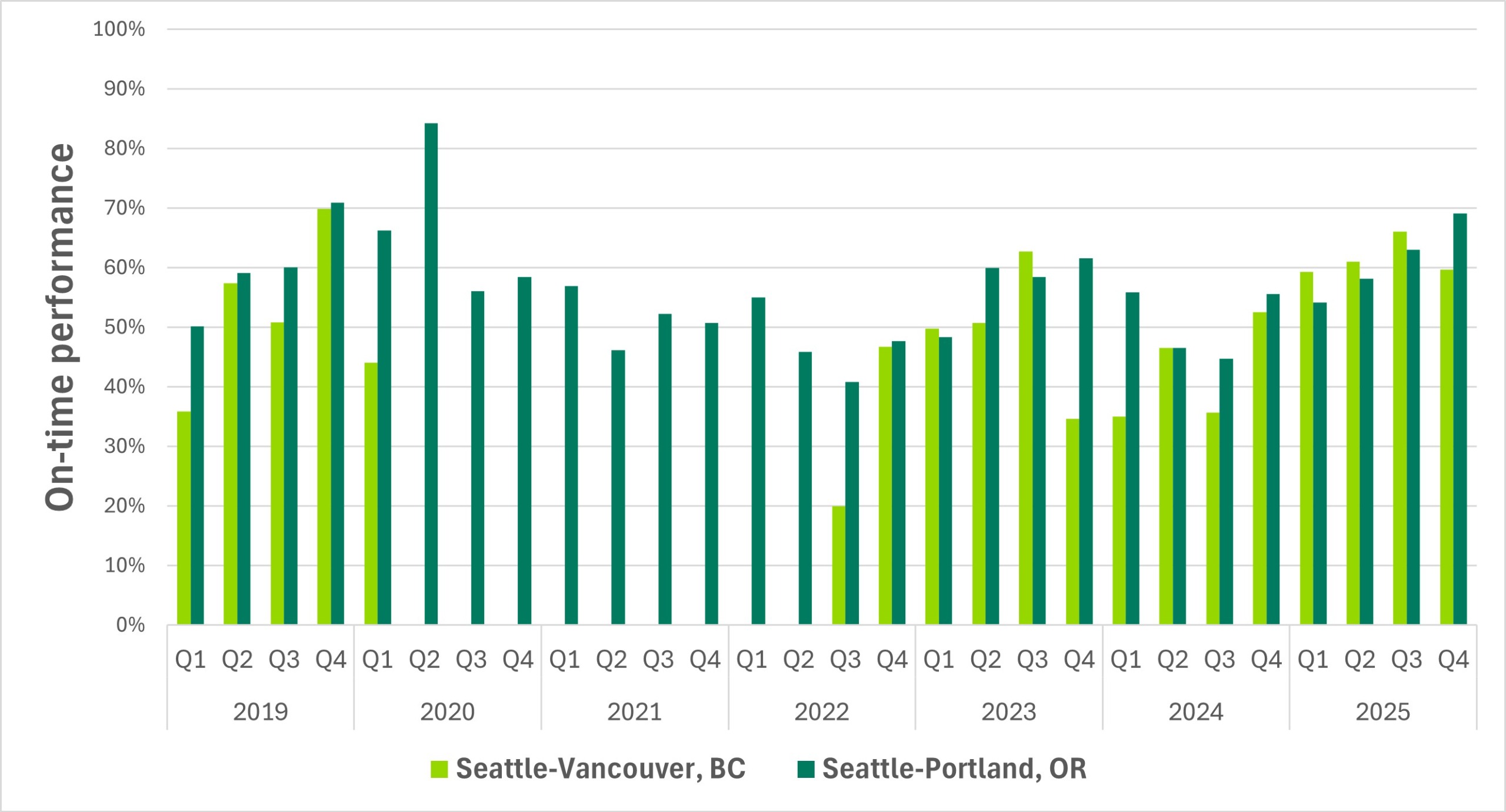
Image description: Annual Amtrak Cascades on-time performance has ranged between 42% and 57% in the last five years. On-time arrival is defined as no more than 10 minutes after the scheduled time. Service was suspended between Seattle and Vancouver, BC from Q2 2020 to Q3 2024 and not shown.

Image description: Annual Amtrak Cascades on-time performance has ranged between 42% and 57% in the last five years. On the bar graph, Seattle-Vancouver, BC service is shown in dark green, and Seattle-Portland service is shown in light green. On-time arrival is defined as no more than 10 minutes after the scheduled time. Service was suspended between Seattle and Vancouver, BC from Q2 2020 to Q3 2024, and not shown.


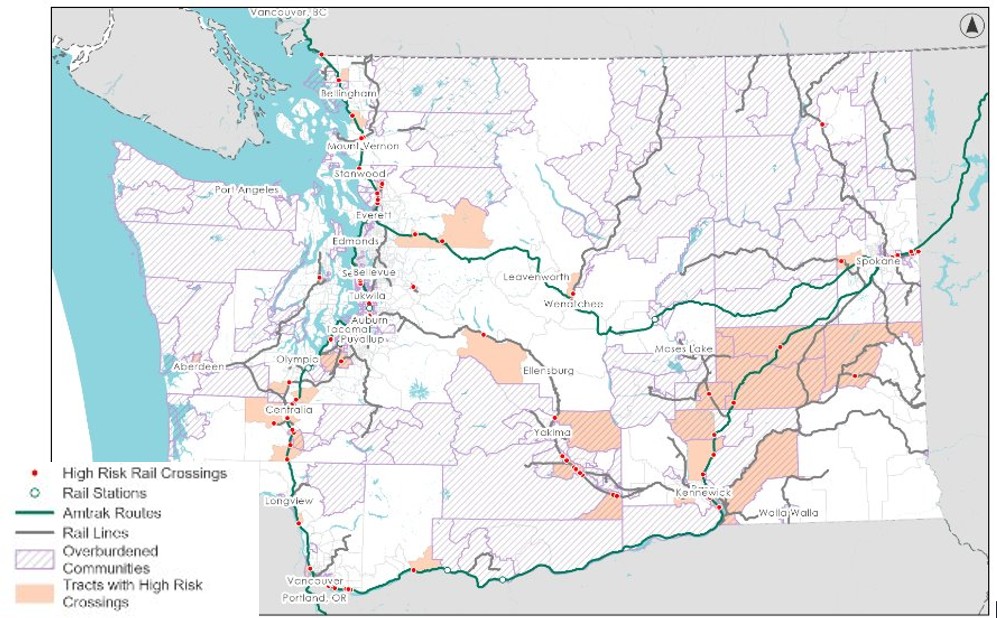
Train-involved injuries and fatalities have been rising; over 70% of all high-risk crossings are located within overburdened communities.

Strategy: Include proposed projects that address safety, including grade separations between railroad tracks and roads.

Image description: Map shows areas where overburdened populations exist across Washington State (gray hashed areas), as well as where high-risk crossings occur. 104 out of 147 total high-risk crossings in Washington State are located in overburdened communities (hashed areas).

Image description: Map shows areas where overburdened populations exist across Washington State (gray hashed areas), as well as where high-risk crossings occur.104 out of 147 total high-risk crossings in Washington State are located in overburdened communities.


Under all growth assumptions, demand will exceed capacity over much of the primary freight rail network without critical investments. BNSF’s primary network is estimated to be at capacity (81%+) for all scenarios. Exceptions are Pasco-Ellensburg-Auburn (Stampede Pass), and Ellinson to Tukwila. BNSF’s I-5 corridor, Columbia River and Stevens Pass routes are projected to operate at well over 100% capacity. Union Pacific is below capacity on all of its primary routes.

Strategy: Include proposed projects that address freight movement specifically.

Strategy: Coordinate closely with host railroads on upcoming passenger service needs and integrated operations.

Image description: Bar graph shows that by 2050, the rail freight forecast shows that the network is projected to haul 36 to 45 percent more tonnage than in 2023. Source: S&P Q3 2025 macroeconomic forecast, STB Confidential Waybill Sample

Image description: Bar graph shows that by 2050, the rail freight forecast shows that the network is projected to haul 36 to 45 percent more tonnage than in 2023.

Source: S&P Q3 2025 macroeconomic forecast, STB Confidential Waybill Sample.


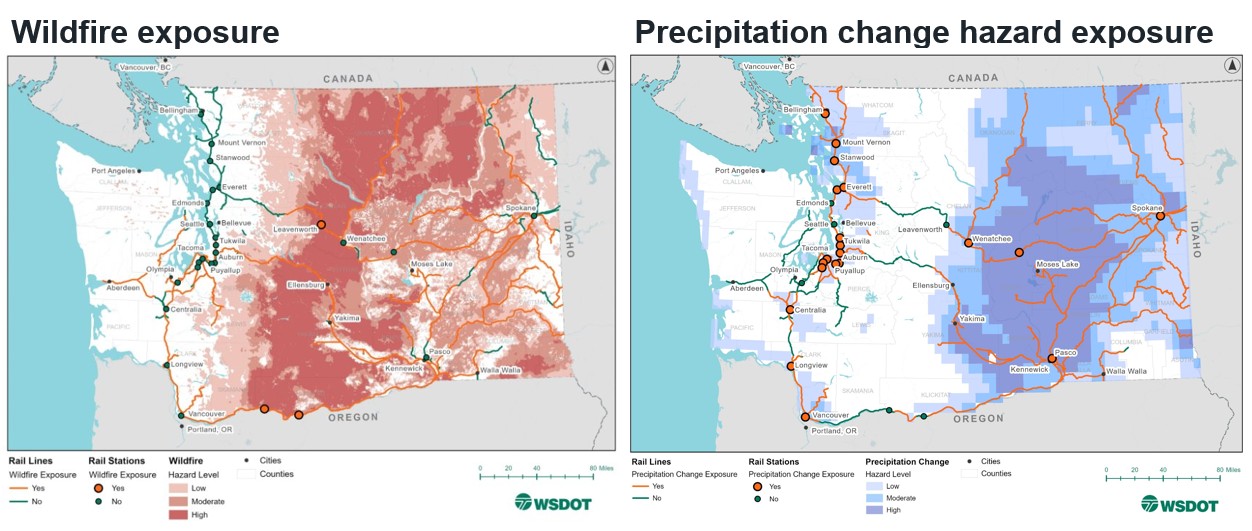
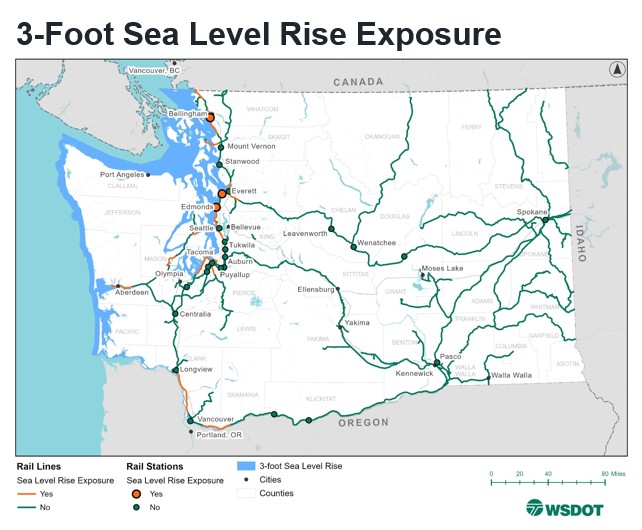
Rail infrastructure contributes to, and is subject to climate change. In coastal settings, the network is exposed, while eastern routes have increasing exposure to rain and wildfire (i.e. landslides, wildfires, floods). 

Strategy: Include proposed projects that can address resiliency opportunities.

Two Washington State maps show exposures in the eastern part of the state that may affect the rail network. For eastern Washington, this includes wildfire exposure, and increased precipitation and potential flood events. One example station area with wildfire exposure is Leavenworth, WA. Pasco and Wenatchee have exposure to precipitation.

Image description: Two Washington State maps show exposures in the eastern part of the state that may affect the rail network. For eastern Washington, this includes wildfire exposure, and increased precipitation and potential flood events. One example station area with wildfire exposure is Leavenworth, WA. Pasco and Wenatchee have exposure to precipitation.

Image description: One map of Washington State shows areas of western Washington with rail lines that could be affected by a 3-foot sea level rise. Bellingham, Everett and Edmonds station areas are exposed.

Image description: One map of Washington State shows areas of western Washington with rail lines that could be affected by a 3-foot sea level rise. Bellingham, Everett and Edmonds station areas are exposed.

Plan timeline

Current, comprehensive data has been analyzed for the 2025 State Rail Plan. Priorities collected from communities and transportation agencies, as well as public feedback, are critical to the analysis. The draft plan is expected this spring, with final submittal to state and federal leaders in summer 2026. The results shared now are a preview of the upcoming draft plan.

There are four steps to engaging with and following the Washington State Rail Plan. 1st, sign up for email updates; 2nd, Join us and engage, currently underway in April, May and June 2025; 3rd, Review the draft plan; and 4th, the Final plan will be submit

Your turn: give your feedback

Please provide a few thoughts about this State Rail Plan preview of key findings.

Thank you

Your feedback and participation for the State Rail Plan will inform the vision for our future rail corridors in Washington state. Thank you.

WSDOT’s Rail, Freight and Ports Division is developing the State Rail Plan. All feedback received will be read and considered by the project team. The draft plan is likely to be published in spring 2026.

WSDOT Title VI Statement

Contact Us

Have questions or want to learn more about a project, contact us below:

🖂 Email: rail@wsdot.wa.gov